
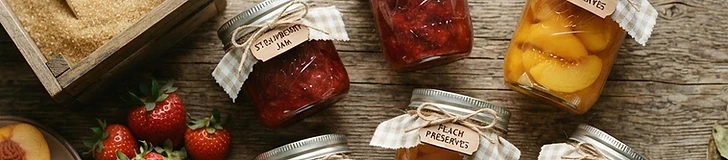
Water-bath canning is the simplest heat-processing method: submerge filled jars in boiling water so the food inside gets hot enough to kill molds and yeasts. The process also drives air out of the jar, creating a vacuum seal as it cools.
It works for high-acid foods only — anything with a pH below 4.6. Most fruit, jams, jellies, pickles, chutneys, and acidified tomatoes qualify.
What you need
- A water-bath canner or any deep pot with a lid and a rack (jars shouldn't sit on the bottom)
- Mason jars with two-piece lids — a flat with rubber seal and a screw band
- A jar lifter, a funnel, and a bubble remover
- A tested recipe — don't improvise ingredient ratios; acid level is the safety control
The basic steps
- Wash jars and keep them hot. Simmer the lids in a small pan.
- Pack the food hot (or raw, whichever the recipe specifies).
- Run a non-metal tool around the inside to release trapped air; adjust headspace to 1/4–1/2 inch.
- Wipe the rim clean, place the lid, and finger-tighten the band.
- Process for the time your recipe lists, adjusting for altitude.
- Lift the jar straight up, set it on a towel, and resist pressing the lid — wait 12–24 hours before checking.
Signs a jar didn't seal
A successful lid is concave and won't flex when pressed. If a lid pops, refrigerate the jar and use the food within a week, or reprocess with a fresh lid within 24 hours.
Start small with one batch. Strawberry jam is forgiving, fast, and good practice before a bushel of peaches.
A note on safety
Water-bath canning is not for low-acid vegetables, meats, soups, or stocks — those require pressure canning. Use a tested recipe from a university extension, the USDA Complete Guide to Home Canning, or the National Center for Home Food Preservation. Old family "open-kettle" methods are no longer considered safe.
When in doubt, refrigerate, freeze, or ferment instead.