
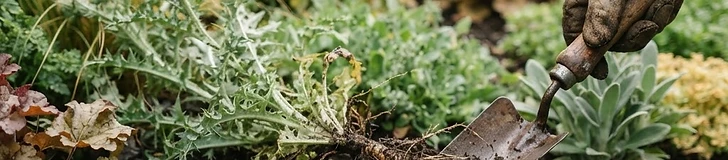
Perennial weeds are the ultimate challenge for home gardeners because they return year after year from deep, established root systems. Unlike annual weeds that spread primarily through seeds, these invaders rely on complex underground networks, meaning simple surface pulling rarely solves the problem. In this guide, you will learn how to identify these persistent intruders and remove them at the source to keep your beds clean.
Spotting Your Targets
Identifying perennial weeds is the first step toward effective removal. Keep an eye out for species that regenerate from broken root fragments left in the soil. Common troublemakers include Taraxacum officinale (dandelion), which features a long, thick taproot, and Convolvulus arvensis (field bindweed), known for its persistent, creeping white rhizomes that can reach depths of 10 feet or more. If you pull a weed and it snaps off while leaving behind a fleshy root, you are likely dealing with a perennial.
The Extraction Strategy
To remove perennials, you must extract the entire root system. If you leave even a small piece, the plant will likely regrow.
- Use a hori-hori knife or a long-handled dandelion weeder to loosen soil at least 6 inches deep around the base of the plant.
- Grasp the crown firmly and pull vertically to prevent snapping the root.
- Work after a light rain when the soil is moist; damp soil releases long roots much easier than dry, compacted dirt.
Pro Tip: If you are dealing with deep-rooted species in hard clay soil, use a broadfork or garden fork to gently lift a large section of earth, then shake the roots free rather than pulling from the surface.
Preventing Regrowth
Once the root is extracted, soil disturbance should be kept to a minimum. Tilling or aggressive digging can bring dormant weed seeds to the surface, sparking a new germination cycle. Instead, apply a 3-inch layer of organic mulch, such as wood chips or straw, to suppress any remaining root fragments that may try to sprout. Monitor your beds weekly, especially in early spring when temperatures reach 50°F, and remove new shoots as soon as they appear to starve the remaining root system of energy.
Consistent removal of the entire root system is the only way to eventually reclaim your garden space from these persistent weeds.