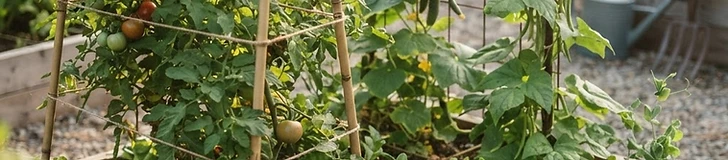
A close-up of a wooden garden bed with a cattle panel trellis supporting bright green cucumber vines and small yellow flowers in a sunny backyard.Square-Foot Gardening

Scaling Upward: Trellising Tall Crops in Square-Foot Beds

2 min read 386 words

Maximize your small-space garden by training vining crops vertically, freeing up precious square footage for lower-growing vegetables.

Maximize your gardening efficiency by training vining crops upward, which keeps your plants healthy and opens your grid for companion crops. Vertical gardening is the secret to getting a massive harvest from a tiny footprint.

Select Your Vertical Candidates Many popular vegetables thrive when encouraged to climb, but you must choose the right ones for your specific square-foot layout. Consider these varieties for your vertical setup:

  • Pole beans (Phaseolus vulgaris): Use 1 square per plant.
  • Indeterminate tomatoes (Solanum lycopersicum): Requires 1 square per plant and heavy-duty support.
  • Cucumbers (Cucumis sativus): Place 2 per square when using netting.
  • Sugar snap peas (Pisum sativum): Place 4-8 per square depending on variety.

Designing Your Trellis Structure To keep your bed sturdy, your supports must handle the weight of the fruit and potential summer winds. For most US zones, a trellis placed on the north side of your 4x4 bed prevents shading your other greens.

  1. Anchor the structure to the bed frame to prevent tipping.
  2. Use cattle panels or heavy-duty nylon mesh for climbing plants to grab.
  3. Ensure the structure is at least 6 feet tall for full-season growth.

Pro-tip: Always install your trellis before planting your seeds or starts; trying to force stakes into a root-dense square-foot bed later in the season risks damaging your crops.

Proper Training and Maintenance As your plants grow, you need to guide them upward to ensure consistent airflow and fruit quality. Gently weave vining stems through the mesh or use soft garden twine to tie them to the frame. When the mercury rises above 85°F, check the soil moisture daily, as vertical plants transpire faster than those resting on the ground. Keep the foliage pruned near the base to improve circulation and prevent common fungal issues.

Harvest Efficiency Vertical growth makes harvest a dream because you no longer have to hunt through thick foliage for hidden produce. The elevation keeps fruit off the soil, significantly reducing rot and pest damage from ground-dwelling insects. This clean approach ensures you can harvest your vegetables at their peak, whether you are in a short-season Zone 4 or a long-season Zone 9. With your vertical structure firmly in place, you are ready to produce a bounty that far exceeds the ground space you started with.

Watch & learn

Curated variety-trial and pest-ID videos related to this article.

How to Build a Simple Garden Trellis

Open
#Square-Foot Gardening#Vertical Gardening#Trellising#Small Space Gardening

More in Square-Foot Gardening

We use a couple of cookies to keep you signed in and remember your settings — no tracking ads, and we never sell your data. Read our privacy policy.