
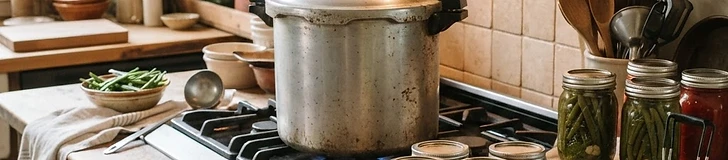
Boiling water never gets hotter than 212°F (100°C) at sea level — not enough to wipe out Clostridium botulinum spores in low-acid foods. Pressure canners trap steam until the internal temperature climbs to 240°F, the threshold the USDA considers safe for vegetables, meats, poultry, seafood, soups, and stocks.
It's the only safe method for shelf-stable low-acid foods (pH above 4.6).
Canner vs. cooker
A pressure canner and a pressure cooker are different tools. Cookers lack the volume, gauges, and venting a safe canning process needs. Look for one labeled "pressure canner" — dial-gauge and weighted-gauge models both work; most hold at least 7 quart jars.
What you need
- A pressure canner with a gauge and vent pipe
- A stove it fits on (canner loads are heavy)
- The usual kit: two-piece lids, funnel, lifter, headspace tool
- A tested recipe — pressure, jar size, and time all change by ingredient
The basic process
- Prep food following the recipe — hot-pack or raw-pack as specified.
- Fill jars, leaving the headspace the recipe calls for (usually 1 inch for low-acid foods).
- Wipe rims, apply lids finger-tight.
- Add 2–3 inches of water; place jars on the canner rack.
- Lock the lid, vent steam for 10 minutes, then close the vent and bring to pressure.
- Start the timer when you hit the target pressure; adjust heat to hold steady.
- Turn off the heat and let the canner depressurize on its own — never force it.
- Remove jars and let them rest undisturbed 12–24 hours.
Altitude matters
Pressure increases with altitude — follow the recipe's altitude table for your elevation, and have your dial gauge checked yearly if you canner regularly.
Many county extension offices test dial gauges for free. An out-of-calibration gauge is a real botulism risk.
Signs it worked
A sealed lid is concave and doesn't flex. Refrigerate any unsealed jar and use within a week.
Pressure canning is more involved than water-bath canning, but it opens the door to year-round shelf-stable meals: homegrown green beans in January, chicken stock without a freezer.