
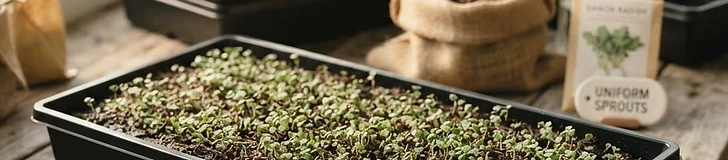
Growing microgreens at home feels magical, but sometimes your trays don't grow quite the way you expected. You might see a patchy harvest where one side is tall and vibrant while the other is stunted or leaning aggressively toward a window. Achieving uniform growth isn't about luck; it's about mastering the three environmental pillars: light, temperature, and airflow. By fine-tuning these conditions, you can produce professional-quality greens on your kitchen counter regardless of your USDA zone or the season. ## Lighting for Even Growth Many home gardeners rely on a sunny windowsill, but this is the primary cause of uneven growth. Sunlight from a single direction triggers phototropism, causing seedlings to stretch toward the light source, resulting in weak, elongated stems. To achieve uniformity, you need light that comes from directly overhead. If you are using supplemental LED grow lights, ensure they are positioned 3 to 6 inches above the canopy. For indoor growers, keep the lights on for 12 to 16 hours daily. If you must use natural light, rotate your trays 180 degrees every single morning to prevent leaning. Remember, while natural light is beautiful, consistent intensity across the entire surface area of the soil is the real secret to a thick, even carpet of greens. ## Managing Temperature for Uniform Germination Microgreens are sensitive to thermal fluctuations. Most varieties, such as radish, kale, and arugula, prefer a sweet spot between 65°F and 75°F. If your grow room is too cold, the germination process slows down, leading to uneven emergence where some seeds sprout days ahead of others. If the room is too hot, the soil may dry out faster than the roots can establish, leading to patchy gaps. In cooler basements or drafty winter homes, a seedling heat mat can provide the consistent bottom heat needed to wake up seeds simultaneously. If you notice mold or damping-off, your temperature might be too high paired with poor ventilation, which encourages fungal pathogens. Always use a thermometer near your trays to keep tabs on the micro-climate they are actually experiencing, rather than just the room temperature. ## The Role of Airflow and Ventilation Airflow is the most overlooked element in microgreen cultivation. Without adequate movement, the air around your plants becomes stagnant, trapping excess moisture and humidity. This creates a perfect breeding ground for mold and prevents the plants from strengthening their cell walls. A small oscillating fan running on a low setting near your trays makes a world of difference. It doesn't need to be a gale-force wind; even a gentle breeze circulating the air prevents hot spots and helps keep the humidity levels balanced. Proper airflow also encourages transpiration, which helps the plants pull nutrients up through their roots efficiently. If your kitchen feels stuffy, prioritize improving the air exchange to ensure your seedlings grow strong stems rather than brittle, spindly ones. ## Practical tips * Rotate your trays 180 degrees daily if you are using natural sunlight to prevent leaning. * Keep a small desk fan on a low setting to prevent stagnant air and mold growth. * Use a seedling heat mat to maintain a consistent 70°F for faster, more uniform germination. * Place your grow lights no more than 6 inches above your trays to promote compact, sturdy stems. * Check soil moisture daily by touch; it should be damp like a wrung-out sponge, never waterlogged. * Maintain a consistent environment to avoid thermal shock, which can cause erratic growth spurts. ## Quick takeaway Consistent light, steady warmth, and gentle air circulation are the fundamental keys to preventing patchy harvests and growing uniform, vibrant microgreens at home.
 Microgreens
Mastering the Environment: The Secret to Uniform Microgreens
3 min read 603 words
Discover how light, temperature, and airflow work together to help you grow consistent, lush microgreens in your home garden.
#microgreens#gardening#indoorgardening#homegrown#sustainability